
Check valves are automatic one-way flow control valves that open under forward pressure and close when flow stops or reverses, helping prevent reverse flow without operator action. Unlike ball or gate valves, they respond to flow conditions on their own.
Shop Check Valves by Type
-
 Swing Check ValvesHinged-disc design with threaded, copper and flanged ends.38 products
-
 Inline Check ValvesCompact inline-body check valves.51 products
-
 Wafer Check ValvesDuctile iron double-door checks that mount between flanges.11 products
-
 Y-Pattern Check ValvesAngled-body Y-pattern check valves.22 products
- Ball Check ValvesBrass ball checks with compression ends.3 products
-
 Specialty Check ValvesAnti-siphon, compressor tank, pneumatic, and single or dual check valves.13 products


Narrow the selection
Application
Standards & Attributes
Guided series

Brass In-Line Check Valves — High Capacity
- Spring-loaded design
- 1/4 in. to 4 in.
- NBR or Viton seal
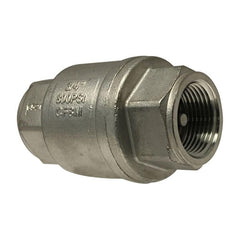
316 Stainless Steel In-Line Check Valves — 800 WOG
- 1/4 in. to 2 in.
- FNPT × FNPT, PTFE seat
- 800 WOG

All Check Valves
The complete check valve catalog, with filters for size, style, body material, end connection, pressure rating and seal material.
Filters
188 items
Sort Featured
-
1/8 in. Inline Check Valve, Midland 947140 -
1/8 in. Brass Spring Check Valve, 500 PSI, Female NPT x Female NPT, NBR Seal -
1/8 in. Brass Spring Check Valve, 500 PSI, Male NPT x Female NPT, NBR Seal -
1/8 in. Brass Spring Check Valve, 500 PSI, Female NPT x Female NPT, Viton Seal -
1/8 in. Brass Spring Check Valve, 500 PSI, Male NPT x Female NPT, Viton Seal -
1/8 in. Brass Check Valve, Female NPT x Female NPT -
1/8 in. Brass Ball Check Valve, Compression -
1/4 in. Hose Barb x 1/4 in. Male NPT Brass Check Valve -
1/4 in. Brass Pneumatic Check Valve, Female NPT x Female NPT -
1/4 in. Brass Inline Check Valve, Buna-N -
1/4 in. Brass Spring Check Valve, 500 PSI, Female NPT x Female NPT, NBR Seal -
1/4 in. Brass Spring Check Valve, 500 PSI, Female NPT x Female NPT, Viton Seal -
1/4 in. 316 Stainless Steel Inline Check Valve -
1/4 in. Brass Check Valve, Female NPT x Female NPT -
1/4 in. Brass Check Valve, Male NPT x Female NPT -
1/4 in. Brass Check Valve, Male NPT x Male NPT -
1/4 in. Aluminum Anti-Siphon Check Valve, Male NPT x Male NPT -
1/4 in. Stainless Steel Barrel Spring Check Valve -
1/4 in. Brass Anti-Siphon Check Valve, Male NPT x Male NPT -
1/4 in. Inline Check Valve -
1/4 in. Stainless Steel Female x Female Spring Check Valve -
1/4 in. Stainless Steel Spring Check Valve, MPT x FPT -
1/4 in. Stainless Steel Y Spring Check Valve -
304 Stainless Steel Check Valve Inlet, 1/4 in. Male Flare


Apex Flow Solutions carries brass, stainless steel, and PVC check valves in spring-loaded inline, Y-pattern, swing disc, barrel, and anti-siphon configurations. Ratings, seals, connections, and sizes vary by product, so confirm the specifications on each product page.
Choose by Material and Style
Brass check valves are offered with Buna-N (NBR) and Viton (FKM) seal options across a range of pressure ratings; confirm the rating, seal, and service on the specific product. Stainless steel check valves (304 and 316) are the corrosion-resistant option for service that attacks brass. PVC check valves are the non-metallic option, in inline and spring-loaded styles. For chemical or material compatibility, confirm the specific product against the manufacturer data.
Anti-Siphon and Metering Pump Applications
Aluminum anti-siphon valves and barrel spring check valves are grouped for chemical metering and dosing work; barrel spring checks connect at the pump outlet port. Match the connection and body material to your pump and line, and confirm compatibility against the manufacturer data.
Related Technical Resources
Frequently Asked Questions
Which type of check valve do I need for my application?
Spring-loaded inline check valves are a common choice for pump discharge lines and process piping. Swing disc valves are often used on lower-pressure, gravity-fed lines. Barrel spring check valves connect at metering-pump outlet ports and are grouped for chemical dosing. The right type depends on your line, pressure, and orientation; see our Check Valve Types Guide and confirm the specification on the product page.
Does a check valve have to be installed in a specific direction?
Yes — check valves are directional and must be installed with the flow arrow on the body pointing in the direction of flow. Installed backwards, the valve will block forward flow and will not prevent reverse flow. Orientation limits vary by valve type and model, so follow the flow arrow and the manufacturer's orientation guidance. See our Check Valve Installation Direction Guide for diagrams.
What is the difference between a spring check valve and a swing check valve?
A spring check valve uses a spring to return the disc to its seat, so it opens once forward pressure overcomes the spring. A swing check valve uses a hinged disc that opens with forward flow and closes under gravity and reverse pressure. The two have different orientation limits and pressure behavior; confirm the rating and mounting orientation on the specific product.
Guides for Choosing
Need help picking the right check valve? Check Valve Sizing Guide · Orientation & Installation · Check Valve Types Compared · Buna vs. Viton Seats · Slamming & Water Hammer